How to Create a Wedding Day Timeline (Sans Ross-Geller-Level Meltdown)
If you’re searching for how to create a wedding day timeline, chances are you’re deep in wedding planning mode.
You’ve pinned the inspiration, toured the venue, and maybe even picked your signature cocktail. But now you’re staring at a blank document thinking…
“How do I actually build a wedding day timeline that makes sense?”
Girl, you aren’t alone.
Creating a wedding timeline is one of the most important (and most overwhelming) parts of planning. Your wedding timeline template impacts:
- Ceremony flow
- Portrait lighting
- Sunset photos
- Reception energy
- And whether the day feels calm… or chaotic
It’s the difference between:
“Pivot! Pivot!” energy
and
Monica Geller-level organization (but joyful and relaxed).
After photographing 100+ weddings and building custom timelines for my couples, I’m walking you through exactly how to create a wedding day timeline step-by-step — with real wedding timeline planning tips, a sample wedding day schedule, and a free 5-step framework you can screenshot.
Let’s do this.

Step 1: Anchor Your Wedding Day Timeline Around Sunset
If you only remember one thing from this entire wedding timeline planning guide, remember this:
Sunset is the anchor of your wedding day timeline.
Before you finalize your ceremony time, reception start time, or build your wedding timeline template, Google:
“Sunset time in {wedding location} on {wedding date}”
Why does sunset matter when creating a wedding day timeline?
Because light determines everything about how your photos look — and how your reception feels.
Golden Hour vs. Midday Light (Yes, This Matters for Your Wedding Timeline)
When planning your wedding day schedule, understand how light works:
Midday Light
- Bright
- High contrast
- Dramatic shadows
- Slightly squinty (we love her, but she’s intense)
Golden Hour (30 minutes before sunset)
- Soft
- Even
- Warm
- Glowy
- The Rachel Green hair flip of lighting
If you love romantic, Pinterest-style portraits, you must protect golden hour in your wedding timeline template.

How to Protect Sunset in Your Wedding Timeline
When creating your wedding day timeline:
- Block off 20–30 minutes before sunset
- Avoid scheduling speeches, cake cutting, or entrances during golden hour
- Leave flexibility 10 minutes after sunset in case color lingers
If sunset portraits are important to you, build your reception schedule around them.
Not the other way around.
Because nothing hurts like realizing your DJ introductions ran long and the sky just did something magical without you.
Step 2: Decide on the 4 Major Wedding Timeline Factors
Before filling in timestamps in your wedding timeline template, you need to make four core decisions.
These are the foundation of any well-built wedding day schedule.
1. What Time Is Your Ceremony?
Your ceremony time determines:
- Portrait order
- Sunset access
- Cocktail hour structure
- Reception flow
If you don’t know your ceremony time yet, many couples reverse engineer it from sunset and reception start time.
When building your wedding day timeline, always consider:
- Daylight availability
- Guest arrival timing
- Venue constraints
2. What Time Does Your Reception Begin?
Your reception start time impacts:
- Dinner timing
- Speeches
- First dances
- Golden hour access
Venue type matters when planning your wedding timeline:
Outdoor Reception
- Light shifts beautifully throughout the evening
Tented Reception
- Diffused light lasts longer
Ballroom Reception
- Artificial lighting is ✨essential✨ to making it feel romantic and not…well, clinical.
Your reception atmosphere should align with your overall wedding timeline structure.

3. Will You Have a Cocktail Hour?
When building a sample wedding day schedule, cocktail hour often acts as your transition buffer.
Cocktail hour allows:
- Post-ceremony portraits
- Family formals
- Guest flow without awkward downtime
A well-structured cocktail hour makes your wedding timeline feel seamless instead of rushed.
4. Will You Do a First Look?
This decision dramatically changes how to create your wedding day timeline.
First Look Wedding Timeline Structure
- Most portraits before ceremony
- Attend full cocktail hour (or more 1:1 portrait time!)
- Less post-ceremony stress
No First Look Wedding Timeline Structure
- Traditional aisle moment
- Portraits after ceremony
- Tighter sunset planning
In my opinion, there is not right or wrong decision here. You need to have an honest conversation about what your priorities are, and then make the decision from there. Both options create beautiful wedding days.
Your wedding timeline template simply adjusts accordingly.
Step 3: Calculate Realistic Timing for Your Wedding Day Schedule
One of the most important wedding timeline planning tips?
Everything takes longer than you think.
Here are realistic timing blocks when building your wedding timeline template:
Wedding Timeline Planning Tips: Photo Timing Estimates
- Getting Ready Photos: 60–90 minutes
- First Look + Couple Portraits: 30–45 minutes
- Wedding Party Portraits: 30 minutes
- Family Formals: 20–30 minutes
- Golden Hour Portraits: 15–20 minutes
- Travel Time Buffer: 15 minutes per location
When learning how to create a wedding day timeline, buffer time is your best friend.
Without buffer time:
- Ceremonies start late
- Stress builds
- Vendors scramble
With buffer time:
- You breathe
- You laugh
- You enjoy
Be Monica. Not chaos.

Step 4: Choose the Right Wedding Timeline Template Structure
Every wedding day schedule falls into one of four structural formats.
Understanding your structure simplifies how to create your wedding day timeline.
Format 1: First Look + One Location
- Efficient
- Relaxed
- Cocktail hour is fully yours
Format 2: First Look + Multiple Locations
- More travel buffer needed
- Portraits spread throughout the day
Format 3: No First Look + One Location
- Ceremony first
- Portraits immediately after
- Sunset protection required
Format 4: No First Look + Multiple Locations
- Most complex timeline
- Travel time critical
- Sunset scheduling must be intentional
Every timeline format has it’s own set of pros and cons. I cannot stress this enough: there are no wrong choices here. Know your priorities, and make decisions accordingly. Inside of my Complete Wedding Day Timeline Guide I walk you throughout each of these timeline formats and how to customize them to meet your specific unique needs.
Step 5: Avoid These Common Wedding Timeline Mistakes
Even the best wedding timeline template can fall apart without awareness of these common mistakes.
Mistake #1: No Buffer Time Between Events
This is the #1 reason wedding ceremonies start late.
When creating your wedding day timeline:
- Add 5–10 minutes between major events
- Build cushion into the morning
- Pad travel time
Trust me — you will not regret extra breathing room.
Mistake #2: Not Sharing the Final Wedding Timeline
Your timeline is only effective if everyone has it.
Send your finalized wedding day schedule:
- 2–4 weeks before your wedding
- As a PDF
- With planner and vendors included
Vendor alignment = smooth execution.
Misalignment = Michael Scott chaos energy.

Mistake #3: Not Scheduling Special Moments
When creating your wedding day timeline, remember:
If it isn’t written down, it usually doesn’t happen.
Add time for:
- Private vows
- Gift exchanges
- Father/daughter first look
- Cake cutting
- Sunset portraits
Do not rely on “we’ll find time.”
Time disappears fast on wedding days.
Screenshot This: The 5-Step Wedding Timeline Framework
Here’s your quick-start checklist for how to create a wedding day timeline:
1️⃣ Find your sunset time
2️⃣ Choose ceremony and reception start times
3️⃣ Decide on first look and cocktail hour
4️⃣ Add realistic photo timing blocks
5️⃣ Build in 10–15 minute buffers
This framework alone will give you so much peace of mind as you continue planning!
Sample Wedding Day Schedule (First Look + One Location Example)
Here’s a simplified example of a balanced wedding day timeline:
2:00 – Getting Ready Photos
3:30 – First Look
3:45 – Couple Portraits
4:15 – Wedding Party Portraits
4:45 – Family Formals
5:30 – Ceremony
6:00 – Cocktail Hour
7:00 – Reception Begins
8:15 – Sunset Portraits
9:00 – Open Dancing
This sample wedding day schedule gives you a strong structural starting point.
Your actual timeline will adjust based on sunset time, venue, and travel. Feel free to adjust specifics as many times as needed as the day gets closer!
FAQ: How to Create a Wedding Day Timeline
How early should getting ready start on a wedding day?
Most wedding day schedules begin getting ready photos 4–5 hours before ceremony time.
Hair and makeup typically begin 6–7 hours before ceremony depending on bridal party size.
How long should family photos take?
Family formals usually take 20–30 minutes when a list is prepared in advance. PLEASE. Prepare this in advance and work with your photographer to make sure your list is doable!
Without a list? It can easily double.
When should sunset portraits happen?
Plan sunset portraits 20–30 minutes before your official sunset time (you already looked this up earlier in this post).
Protect that window in your wedding timeline template.
Do I need a wedding timeline template?
Yes.
Even if you customize it heavily, starting with a structured wedding timeline template prevents major gaps and missed moments.
How to Create a Wedding Day Timeline That Feels Calm (Not Chaotic)
Your wedding timeline isn’t about micromanaging your day.
It’s about protecting your experience.
A rushed wedding day schedule feels like:
- Running
- Stress
- Missed light
- Missed moments
A well-built wedding timeline feels like:
- Breathing room
- Seamless transitions
- Confidence
- Joy
Structure creates freedom.
Even Monica would agree.
Want a Photographer-Approved Wedding Timeline Template?
If you’re realizing that building a wedding day timeline involves more moving parts than you expected — you’re right.
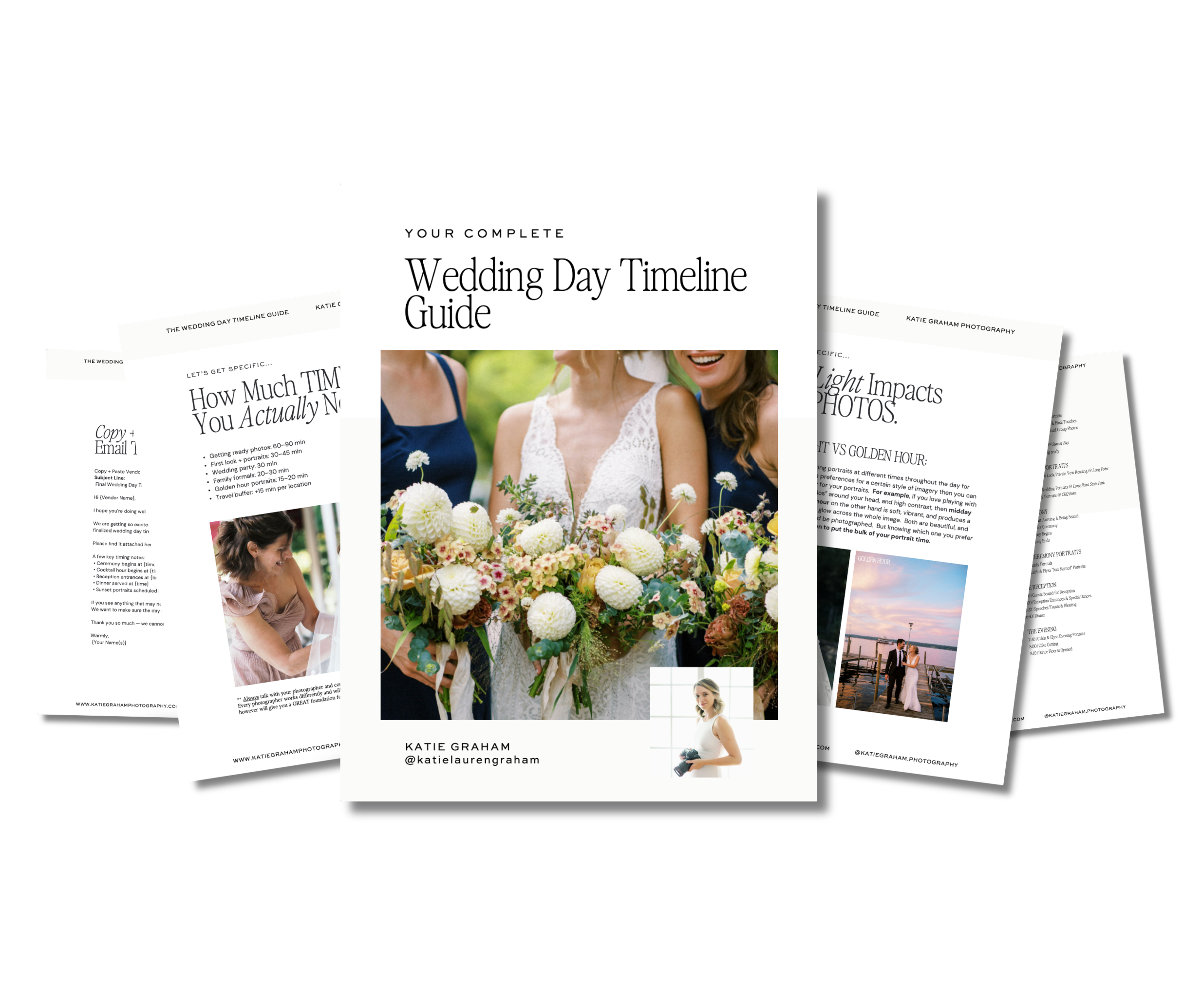
That’s why I created my Wedding Day Timeline Guide.
Inside, you’ll find:
- Drag-and-drop wedding timeline templates
- Real wedding day schedules
- A full timeline questionnaire
- Sunset planning guidance
- Built-in timing recommendations
- A vendor email template
If you want a fully built wedding timeline template with real examples and sunset planning guidance, my Wedding Day Timeline Guide walks you through it step-by-step.
Final Reminder
If it isn’t written down, it usually doesn’t happen.
Your wedding day timeline is the structure that protects your experience.
Build it intentionally.
Share it clearly.
Then relax.
Because when your timeline flows beautifully?
You won’t feel like Ross yelling “We were on a break!”
You’ll feel calm, present, and fully in your moment.
📌Pin this for later on Pinterest!


join the email list
be the first to know when mini sessions become available!
